Jan Swasthya Abhiyan (JSA, PHM India) sends its letter to the PM - A model Petition which can be used
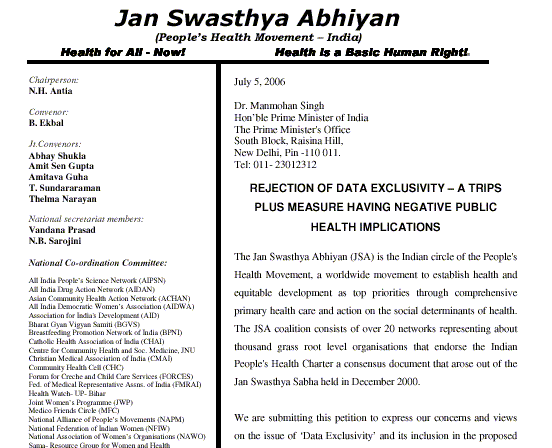
Jan Swasthya Abhiyan ( PHM India) sent its letter to the PM at the stroke of the beginning of the action week of July 6th to 10th 2006.
July 5, 2006
Dr. Manmohan Singh
Hon’ble Prime Minister of India
The Prime Minister's Office
South Block, Raisina Hill,
New Delhi, Pin -110 011.
Tel: 011- 23012312
REJECTION OF DATA EXCLUSIVITY – A TRIPS PLUS MEASURE HAVING NEGATIVE PUBLIC HEALTH IMPLICATIONS
The Jan Swasthya Abhiyan (JSA) is the Indian circle of the People's Health Movement, a worldwide movement to establish health and equitable development as top priorities through comprehensive primary health care and action on the social determinants of health. The JSA coalition consists of over 20 networks representing about thousand grass root level organisations that endorse the Indian People's Health Charter a consensus document that arose out of the Jan Swasthya Sabha held in December 2000.
We are submitting this petition to express our concerns and views on the issue of ‘Data Exclusivity’ and its inclusion in the proposed amendment to the Drug and Cosmetics Act. We urge you to consider these concerns and withdraw any move to amend the above Act, or to include ‘Data Exclusivity’ in any legislation. Looking forward to your early action in this regard. In case you need more information, we would be happy to provide the same.
OUR CONCERNS ON THE ISSUE OF DATA EXCLUSIVITY ( in a box)
1) The TRIPS agreement does not refer to data exclusivity at all. It only refers to data protection against "unfair commercial use".
2) Data exclusivity has become a means of preventing generic competition, which greatly restricts access to medicines.
3) The cost of generic drugs and the costs of health care are bound to increase, which is a wasteful expenditure, which a country like ours cannot afford.
4) It is unethical to conduct clinical trials on drugs which have already been proven effective
5) The civil society in the country and even experts from within the Government have opposed the amendment because of the impact it will have on people and people’s access to medicines.
6) This move to include ‘data exclusivity’ is a ‘TRIPS-plus’ agenda, which is anti- people and against people’s interest. It is being pushed by vested interests including large Multi-National Corporations and certain foreign governments.
4) It is unethical to conduct clinical trials on drugs which have already been proven effective
5) The civil society in the country and even experts from within the Government have opposed the amendment because of the impact it will have on people and people’s access to medicines.
6) This move to include ‘data exclusivity’ is a ‘TRIPS-plus’ agenda, which is anti- people and against people’s interest. It is being pushed by vested interests including large Multi-National Corporations and certain foreign governments.
Compliance with TRIPS
In complying with the TRIPS norms, India amended the Indian Patents Act, 1970 for the second time as recently as two years back against much public opposition. This move to further alter Indian legislation to supposedly comply with TRIPS requirements is an unwarranted step. In fact, the TRIPS agreement does not refer to any period of data protection, nor does it refer to data exclusivity.
Article 39.3 of TRIPS says that WTO Members should protect "undisclosed test or other data" against "unfair commercial use" and "disclosure". Nowhere does TRIPS state that countries should provide exclusive rights to the originator of the data for a given period. Rather, TRIPS simply refers generally to the need for "data protection". Data protection against unfair commercial misuse as mentioned in TRIPS is totally different from data exclusivity. The use of data by the Drug Controller is a legitimate, non-commercial use and is TRIPS compliant.
TRIPS plus – An Anti-People Agenda
In fact, the Report of the Commission on Intellectual Property Rights, Innovation and Public Health (CIPRIPH) has clearly cautioned countries from placing unnecessary data protection norms. In page 143, it clearly says "Article 39.3, unlike the case of patents, does not require the provision of specific forms of rights. […] It does not create property rights, nor a right to prevent others from relying on the data for the marketing approval of the same product by a third party, or from using the data except when unfair (dishonest) commercial practices are involved." In page 144, it states, "…developing countries should not impose restrictions for the use of or reliance on such data in ways that would exclude fair competition or impede the use of flexibilities built into TRIPS".
Access to Drugs
It is clear that data exclusivity could prevent the registration of generic versions of medicines even when there
is no patent on a medicine. For instance when a pharmaceutical does not meet the standards for patentability
or when no patents are granted for pharmaceuticals, the data could still come under ‘data exclusivity’ norms.
Data exclusivity has thus become a means of preventing competition from Indian manufacturers, which greatly restricts access to medicines. As the Global AIDS Alliance and the others working on ‘access to drugs’ have pointed out, such amendments will have adverse effects on the global availability of affordable essential medicines meant then companies would be prevented from taking marketing approval even if they have been granted compulsory license to use a patented substance during the period the data exclusivity is in operation.
Unethical Practice
Denial of reasonably priced generic equivalent to people who cannot afford costly drugs is also unethical. Many of these drugs are those whose patent protection period has expired. Using the drug control infrastructure to do policing for pharmaceutical companies by introducing data exclusivity in the Drugs and Cosmetics act is highly unethical.
Health Care Costs
In a country where most of the spending on health is through out-of-pocket expenditure and the provision of government services is limited, any increase in cost of drugs is bound to adversely affect people’s access to drugs. A duplication of clinical trials is bound to increase the cost of drugs and is a wasteful expenditure, which a country like ours can ill-afford. As the Report of the CIPRIPH states, the United Nations Special Rapporteur on the Right to Health commented on the possible additional health-care costs relating to the introduction of data exclusivity in the Free Trade Agreement between the United States and Andean Pact countries.
Mismatched Responsibilities
The drug regulatory authority is a body set up as a public authority. Its function is to ensure, in public interest, that drugs that are provided with marketing approval meet the criteria of safety, efficacy and good quality. Drug Regulatory Authorities need be concerned with safety and efficacy of a drug, and are not supposed to involve themselves with the patent status of a drug. By amending the Drugs and Cosmetics Act, Drug Regulatory Authorities will be required to look at the Patent status of a drug, which does not fall under their domain. Under the guise of Data Exclusivity, what is really being sought is that drug regulatory authorities should act on behalf of pharmaceutical companies to safeguard their monopoly right.
The recent WHO Briefing Note on Access to Medicines emphatically states that efforts to integrate the intellectual property system and the drug regulatory system via data exclusivity, "linkage" or other means are likely to have negative implications for access to medicines. It calls on countries to keep these systems separate, and to reject any and all efforts to make connections between them.
Opposition from Within
What is the Alternative?
Instead of seeking to further expand the scope and duration of ‘exclusive rights’ of drugs and agro-chemical products, India should seek to encourage competition from Indian manufacturers. A minor addition to the Drugs and Cosmetics Act which says ‘test data provided by a company will not be made public or shared with its potential competitors for five years’ is enough to meet the requirements of TRIPS. This does not prevent the Drug Regulatory Authorities from relying on the data to license a generic version of a new drug. The urgent need of the hour is to improve people’s access to drugs and to make drugs affordable. We comprehensively reject the idea of introducing data exclusivity, as it will have serious public health implications. We hope the govt will chose to implement amendments in the Drugs and Cosmetic Act in a manner that will strengthen drug regulation, address the issue of quality and ensure access to essential affordable generic drugs.
Sincerely,
(Dr. B. Ekbal) and (Dr. Abhay Shukla)
National Convenor and National Secretariat
posted by Prasanna Saligram @ 7:29 AM
0 comments


0 Comments:
Post a Comment
<< Home